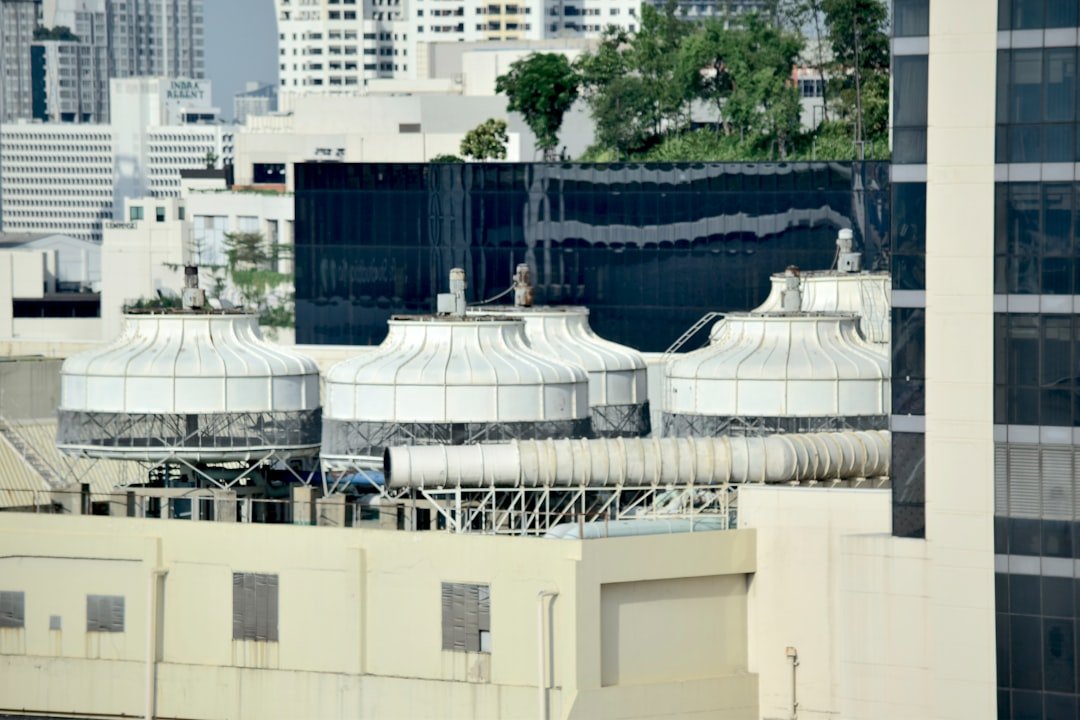
When building owners in Kuala Lumpur, Bangkok, or Jakarta talk energy, they talk roofs, glazing, and insulation. Those conversations are worth having — but they are happening in front of the wrong bill.
In ASEAN’s tropical corridor, air-conditioning and mechanical ventilation (ACMV) systems typically account for 40 to 60% of a commercial building’s total energy consumption, according to Singapore’s National Environment Agency. Within that, the chiller plant itself represents roughly 55% of ACMV energy use — making the chiller responsible for between 22% and 33% of a building’s entire electricity spend. For a large Grade A office tower running 24 hours, that translates directly into one of the largest single line items on the operating account.
The IEA projects that electricity demand from space cooling in Southeast Asia could reach 300 TWh annually by 2040 — roughly equivalent to the combined total electricity consumption of Indonesia and Singapore today. The region’s air-conditioner stock is forecast to grow from approximately 50 million units in 2020 to 300 million by 2040. That trajectory makes chiller plant efficiency a portfolio-level financial risk, not an engineering footnote.
How Chillers Actually Waste Energy
The most persistent assumption is that a chiller running is a chiller running efficiently. It rarely is.
Commercial buildings in ASEAN cities almost never operate at design cooling load. Meeting rooms empty, occupancy shifts with hybrid work patterns, weekend demand collapses. A chiller sized for peak conditions on a humid Wednesday afternoon will frequently run at 30–60% partial load — and the majority of installed units were not optimised for part-load efficiency at commissioning. Three specific loss mechanisms compound the problem:
- Condenser water temperature drift: Chiller efficiency is acutely sensitive to condenser water return temperature. Systems that do not dynamically reset setpoints based on actual wet-bulb conditions can lose approximately 4% of chiller efficiency per degree Celsius of avoidable condenser lift — a constant drain that rarely appears in any dashboard.
- Static chiller sequencing: Running a single large chiller at 30% load is typically far less efficient than staging across two smaller units at higher individual loads. Without intelligent sequencing logic, operators default to conservative, single-chiller configurations because the risk of a comfort complaint outweighs the incentive to optimise.
- Fixed chilled water supply temperature: Running chilled water 2°C warmer than the minimum required for comfort still meets occupant specifications while saving roughly 4% of chiller energy per degree. Most systems run colder than necessary because the setpoint was established at commissioning and has never been revisited against actual load profiles.
Each of these losses operates silently. They do not trigger alarms. They do not appear in fault logs. They accumulate as a permanent, invisible premium on every electricity bill.
What AI Analytics Is Delivering in Practice
Independently verified performance data from the past two years establishes what AI-driven chiller optimisation actually achieves beyond vendor claims.
A 2025 study applying supervisory control with advanced sequencing algorithms to a commercial building chiller plant documented daily energy savings of approximately 3,945 kWh alongside a 4.2% improvement in chiller plant coefficient of performance (COP). A separate deployment across multiple commercial buildings using AI-enabled setpoint management and predictive sequencing achieved energy savings of up to 21%, with chiller plant COP improving by as much as 47% relative to baseline operation.
The technical approach enabling these results combines model predictive control with machine-learning-based cooling load forecasting. XGBoost-based load prediction models applied to live data from commercial buildings in Singapore have demonstrated a 46.5% improvement in cooling load prediction accuracy over conventional methods — the accuracy gain that allows setpoints to be optimised in advance rather than corrected after the fact.
The data integration requirement is modest by current standards: building automation system (BAS) outputs, sub-metered electricity consumption, external weather feeds, and occupancy schedules. In buildings where this data already exists but sits unconnected in separate systems, the optimisation layer requires no new sensors.
Two Regulatory Fronts Are Closing
Two parallel regulatory shifts are forcing chiller performance onto executive agendas across ASEAN.
In Malaysia, the Energy Efficiency and Conservation Act (EECA) came into effect on 1 January 2025. It targets approximately 1,200 buildings — just 4.3% of the commercial building stock — but that cohort accounts for an estimated 66% of the sector’s total energy consumption. Buildings consuming more than 21,600 GJ annually, or office buildings of 8,000 square metres or more with a Building Energy Intensity exceeding 250 kWh/m² per year, now face mandatory energy audits conducted by registered auditors, mandatory Energy Management System implementation, and public display of their energy intensity label. Penalties apply to non-compliant designated consumers.
In Singapore, the Building and Construction Authority announced its Mandatory Energy Improvement (MEI) programme in September 2024, requiring existing commercial buildings to undergo audits and implement improvement measures. The BCA’s Green Mark 2021 framework also introduced a Total System Efficiency (TSE) metric — measured in kW/RT across the full ACMV system — with GoldPLUS certification now requiring a TSE below 0.80 kW/RT. This holistic metric means chiller efficiency can no longer be assessed in isolation from the pumps, fans, and controls it interacts with.
Thailand and Indonesia are separately advancing building energy codes that place increasing weight on HVAC system performance, creating a regulatory tide across the ASEAN portfolio landscape rather than isolated national requirements.
The Portfolio Question Worth Asking Now
For a facilities or asset management team holding multiple commercial assets, the diagnostic question is straightforward: what is the current kW/RT at typical operating conditions for each chiller plant, and how does that compare to the installed plant’s rated performance?
The gap between those two numbers — commonly 15–30% in older, unoptimised systems — represents the direct addressable opportunity. Buildings constructed before 2015 with original plant controls are the strongest candidates for sub-optimal sequencing and fixed setpoint management. Buildings that have undergone envelope retrofits without addressing the plant room may have reduced their cooling loads while leaving the efficiency logic unchanged, creating a new mismatch between the chiller’s original sizing assumptions and actual demand patterns.
Identifying which assets in a portfolio carry the largest chiller efficiency gap — before an auditor does it on behalf of a regulator — is a matter of financial management rather than technical housekeeping.
For building owners and facilities teams exploring where chiller analytics might apply across their portfolio, connect@technicityland.com is open for a conversation.
Interested in Japanese Deep-Tech for Your ASEAN Operations?
Technicity bridges Japanese bio-process innovation into ASEAN markets. Tell us about your needs and we will connect you with the right technology.